|
|
| After you have nurtured your young Redwoods and re-potted them each year, they will eventually be too large to keep in a container and will need to be planted into the ground. The first problem is finding a suitable location. These are big trees and although they can grow well in a crowded area, they will not look their best. Also, they do not like shade, once again they will grow but will not produce branches in heavily shaded areas. Ideally, if you do not have a large garden yourself you could find someone who has. Failing that you could join the growing band of guerrilla gardeners and plant them out in an under-utilised public space. If you do this, then naturally you must take great care in choosing an appropriate location. |
| Building a small guard will help protect your trees from rabbits and other nibblers while in their formative years. This is not always necessary, but we have found that occasionally an un-protected one will fall foul of the unwanted attentions of animals. For each guard you will need the following: |

A pack of staples - again non-galvanised if possible |
- Wire netting - we would recommend non-galvanised 1" chicken wire so it will rust away in a few years and provide the tree with important iron, although you may get strange looks when the shopkeeper tells you that the cheap stuff will just rust, and you say "Good!"
- Sticks of untreated wood - again so it will rot away naturally and definitely not hardwood - that is best left in the rainforest. 3.5cm x cm and 32cm in length. Saw to a point at one end to help when hammering into the ground. The sides of old fence panels are ideal, although they may have been treated.
- A pack of staples.
- A saw.
- A claw hammer.
- A helpful assistant (not essential but quite handy).
|
| Here is One I Made Earlier |
| For a 1 metre high guard: |
 |
- Cut a strip of the chicken wire approx. 135cm long.
- Take 3 sticks of your sawn-to-size wood and lay them on the floor at approx 45cm apart.
- Place your chicken wire over the wooden sticks, with one end resting on the first stick.
- Staple the chicken wire to all of the wood sticks.
- Turn the whole thing over.
- Fold the first wooden stick over and then bend the other end of the chicken wire until it is resting on the first wood stick, then staple this too.
|
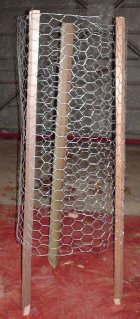
The finished guard |
| A simpler method: |

Twist the free ends together |
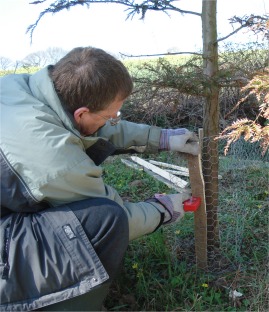
Staple the wire mesh to the wooden sticks |

Protected from nibblers |
Experience has ensured my guard making skills have evolved! Here is a method that needs less preparation and is ideal for situations where the tree is already quite large and you would not be able to slip a fully prepared guard over the top of the tree.
Take an appropriate length of chicken wire and two or three wooden sticks with you to the tree. Wrap the chicken wire around the trunk and twist the free ends of the wire together. Then insert the sticks inside of the chicken wire circle and hammer with a rubber mallet, taking care to keep the sticks close to the wire. Make sure the wire is positioned in contact with the ground all around and secure the wire onto the sticks with a staple gun. This will need to be a fairly robust staple gun, the type bought from a hardware store rather than an office supplier.
But you could probably work this out for yourself! |
It seems unlikely that many people need instruction on digging a hole, so we shall not give any! It is possible to find many different forms of advice on digging in a tree from digging square holes (so the roots do not go round in circles) to teasing the roots out to encourage them to spread. You just have to decide what is sensible but we recommend at least loosening the soil a little around the hole and working in some compost if you have any available. In all probability it will be the environment, wildlife and how good a specimen the tree is itself that will determine its survival, rather than how nicely you dig your hole. A little luck will help too.
During the first couple of years you can increase your sapling's chances with the occasional visit with a plastic bottle of water and by clearing away any tall weeds. |
| One day when you are walking in a remote woodland and stumble across an unusual small pine tree, or perhaps you are driving along a dual carriageway and spot an unexpected young Redwood growing high up on the verge, you might well wonder if they were Redwood trees planted illicitly by a guerrilla gardener. |

Dawn Redwood in Autumn colours |
The term "Guerrilla Gardening" originated in the U.S.A. in the 1970's. Groups of people gather to place seeds and plants in neglected corners of public space. More recently Richard Reynolds has been doing a fine job of rallying willing troops to the cause in the U.K. See his web site www.guerrillagardening.org for more details.
Would we encourage others to plant Rogue Redwoods? Certainly, just as long as you choose an appropriate location and obviously not on privately owned land unless you have permission. Always check for the closeness of electricity pylons, telephone wires or buildings and try to choose somewhere that will provide shelter and water. Also bear in mind that you will need to avoid underground services, i.e. gas, water or sewerage pipes. Avoid slopes if possible, as large trees will find it harder to keep stable in storms. If there is a choice, somewhere fairly close to a pond or lake would help see the tree through very dry summers. |

Giant Redwood |
| These trees may be planted in a place that some people deem to be "wrong" but we hope they will eventually look upon them as legacies - a gift to future generations to gaze up in awe, just as many people do with the Giant Redwoods that were planted in the Victorian era. As soon as they are big enough to be in need of protection hopefully someone will place a tree preservation order on them to hold back greedy developers. |
As to those xenophobes who would argue that Redwoods are not "indigenous" please read our Native Page. We have nothing against oak or ash or any other type of tree but there is room for other species too, especially one that was re-introduced in the 1850's (after several millions years of absence). Before complaining, think about the diversity that we would be missing if we do not plant specimen trees. I wonder if those who do complain for reasons of non-nativeness have ever thought about sending the tulips in their garden back to Turkey, (no, they are not originally from Amsterdam) or their potatoes back to the Andes?
In terms of the local ecology, there is no danger presented by Giant Redwoods. They are not at all invasive, and in fact outside of a huge forest environment they will only reproduce with a considerable amount of assistance.
All of the positive points to growing trees of any kind could be multiplied when it comes to growing Redwoods because of their size and speed of growth:
- They provide habitats for wildlife
- Serve as a noise barrier
- Provide visual screening
- Visually soften the town environment
- Soak up flood water
- Soak up CO2
Something that should not be forgotten is the important role trees play in reducing flooding. Britain's winter of 2013 demonstrated the need for more trees in this respect, in and around towns and surrounding hills. A couple of huge evergreen trees will dispose of vast quantities of winter rain water.
Finally one of the greatest reasons cited for growing a tree is that it will take carbon dioxide out of the atmosphere. Taking the long term view, what better tree to plant than one that grows to immense size over a vast period of time. Not only taking huge amounts carbon out of the atmosphere but also holding it there for thousands of years instead of dying and returning it after just a hundred or so.
|
In July 2015 Matthew Auman wrote from America to say, "I am another giant sequoia enthusiast in the U.S. and am publishing a blog post on how much carbon dioxide a full grown giant sequoia could sequester."
In August 2015 Matthew wrote again to say, "I finally completed the project, and per my calculations, the General Sherman sequoia has sequestered 86.7 years of an American's carbon dioxide emissions in its above ground volume.".
If you would like to read more, here is a link to the result of his research; The Planet's Lungs - Planting Giant Sequoias To Combat Carbon Dioxide
|

|
|